|
(click on smaller Schloss Tambach images below to enlarge) |
|
|
|
(click on smaller Schloss Tambach images below to enlarge) |
|
|
During the final stages of the Second World War, enemy State documents were captured on a scale which was unique in history. Beginning with a more or less accidental haul of papers in Paris, specially organized Intelligence units tracked down one German hiding-place after another, until, with few exceptions, they had recovered most of the German archives.
The largest and most important haul of documents was made at Schloss Tambach, near Coburg Germany (due east of Frankfurt am Main), where some 60,000 files of the German naval archives, together with the historians guarding them, were captured. These documents contained practically all the signals, ships' logs, diaries, memoranda, etc., relating to the German Navy from 1868 until the date of their capture—April 1945. When they came to be examined, four sets of papers stood out in importance: the minutes of Hitler's conferences with the Commander-in-Chief of the Navy; the War Diaries of the Naval Staff; operational orders covering every major activity, military and political, in which the Navy had been concerned; and the personal files of Raeder who had been Commander-in-Chief from 1928 until January 1943.
Ref: Hitler and His Admirals by Anthony Martienssen
Specifics of the discovery of the Tambach Castle seizures:
| The capture of German naval records: With the war at sea won and the Allies sweeping through Germany, one of the key objectives of the British Admiralty in the spring of 1945 was the capture of high-grade naval intelligence.* Prior to the invasion of Normandy it had been agreed with the United States that such material would fall under joint US and British ownership but be held in custody by the Admiralty's Naval Intelligence Division, Section 24 (NID 24). This in turn led to the formation of a joint committee, the Target Intelligence Committee (TICOM), which was charged with identifying the key locations of material in all military areas and intercepting personnel and documentation believed to be evacuating Berlin before the Allied advance. From the naval perspective the breakthrough came on 10 April when a tip-off led a small naval intelligence team (NTS 55) commanded by Lt Cdr T. J. Glanville RNVR to a building occupied by the German Naval War Staff (Seekriegsleitung - SKL) in Bad Sulza, twenty miles east of Weimar. The target, a former technical college not on TICOM's list, turned out to be one of many such occupied by the SKL and at first promised little, with 'all the rooms ankle-deep in papers, broken glass, clothes and sundry other items. In the cellar and in the courtyard there was evidence of the burning of documents'. However, among the wreckage a charred piece of paper was found providing a list of other SKL outposts, including one by the name of Tambach. It was to be a critical find. The most obvious Tambach, a town in nearby Thuringia, gave no sign of having been an SKL outpost. However, perusal of a cultural gazetteer turned up another possibility: a remote settlement overlooked by a castle near Coburg in Bavaria. The team arrived shortly before nightfall on 25 April 1945 to find that while Coburg had been occupied by the Americans two weeks before, Tambach and its castle had escaped scrutiny. Entering the castle unannounced, Glanville and his team first accepted the surrender of a bewildered German naval rating and then performed a cursory search which revealed a haul beyond their wildest dreams. They had captured, virtually intact, the central archive of the German navy from 1850 to 1945, the records having been removed from Berlin in November 1943 as the Allied blitz intensified. Despite the protestations of Admiral Walter Gladisch, the senior German naval officer present, that the records had been spared destruction because 'Donitz had ordered they be preserved and handed over to the Allies as evidence that the Kriegsmarine had acted throughout in accordance with humanitarian principles and the traditions of the sea', the preservation of the material was by no means a fait accompli and Glanville had to take urgent steps to secure the trove with the few men at his disposal. Not only had Gladisch removed certain classified papers to his headquarters in a nearby farmhouse for protection, but several SKL women auxiliaries had attempted to burn some records. Although this fire was extinguished Glanville feared further such attempts with the possible assistance of SS units still believed to be in the area. A battalion of troops was deployed to guard the castle and in an operation supervised by officers from the Admiralty's Naval Intelligence Division - including one Cdr Ian Fleming RN VR who later found fame as an author - the documentation from the Third Reich was packed into beer crates and transported to Britain in the first few weeks of May. Such was the volume of material that the packing of the rest took several more months. By July 1947 an exhaustive cataloguing and microfilming process led by the US Navy's Office of Naval Intelligence at 20 Grosvenor Square in London had resulted in the production of several thousand miles of film catalogued under the NID's archival acronym PG - 'Pinched German'. Copies were initially held by the US National Archives and the British Admiralty. Following a series of formal requests for restitution by the Federal German government, the original documentation was returned to Germany between 1959 and 1977, the documents relating to the U-Boot-Waffe being among the last to be repatriated. The original Kriegstagebucher are now housed in the Bundesarchiv-Militararchiv in Freiburg-in-Breisgau, Baden- Wiirttemberg where they are available for consultation by historians and researchers. *See R. M. Coppock, Capture of the German Naval Archive at Tambach in 1945 (NHB, T.57475, 1995), Howard M. Ehrmann, "The German Naval Archives (Tambach)' in Robert Wolfe, ed., Captured German and Related Records: A Naval Archives Conference (Athens, Ohio: Ohio University Press, 1974), pp. 157-72, and Paul Heinsius, „Der Verbleib des Aktenmaterials der deutschen Kriegsmarine. Das ehemalige Marinearchiv, Marinegerichtsakten und Personalakten, Krankenakten sowie Druckschriften und Bibliotheken" in Der Archivar VIII (April 1955), pp. 75-86. Ref: U-BOAT ATTACK LOGS - A Complete Record of Warship Sinkings from Original Sources 1939-1945 by Daniel Morgan & Bruce Taylor |
Source: "The Game of the Foxes, The Untold Story of German Espionage in the United States and Great Britain During World War II", by Ladislas Farago. published by David McKay Company, Inc., New York - 1971. Library of Congress Catalog Card Number: 72-179352. "Introduction: How the Abwehr Papers Were Lost and Found", pp. xi - xv. Partial excerpt as follows:
"During the final weeks of the warin 1945, the badly mauled German roads were cluttered with convoys of trucks carrying the Archives of the Foreign Ministry, the Wehrmacht High Command, Himmler's organizations and other key agencies, in a race to outdistance the rapidly advancing Anglo-American forces. It was a futile attempt. On April 19, units of the First US Army discovered more than 300 tons of Foreign Ministry documents with inumerable copies of Abwehr papers among them. Shortly afterward, other archives were found in Bavaria, all intact. Still in April, at Tambach, advance elements of General Patton's Third Army captured a convoy carrying the entire historical record of the German Admiralty, including the original of its super-secret war diaries and the logs of U-Boats.
Orders to destroy the secret archives had been issued on April 10, and among the papers then burned were those of the Wehrmacht-Fuehrungs-Stab of General Jodl, the Gestapo archives in the Prinz Albrecht Starasse, and the files of the Abwehr in Zossen. But in most cases the orders were either disregarded or carried out so slowly that when the American, British and French units arrived at the Nazi hideouts, they found that only a fraction of the files had been destroyed. Although many key documents were missing in one or another place, they were not obliterated alltogether..."
For further details regarding the Tammbach records, I would refer you to the numerous recent archived material available within the US Department of State web publications in reference to the recent Holocaust studies. Many of the finding aids contain detailed mention of the exact military units which were responsible for the seizure of key documents, at Tammbach and elsewhere. Hope that this was of some help.
Edward Michaud
Trident Research & Recovery, Inc.
|
|
In April 1945, as the Nazis retreated, a group of British Naval Intelligence commandos, a unit set up by none other than Ian Fleming, captured rhe entire German admiralty archives at Tambach Castle near Coburg Germany. Fleming himself traveled to Germany to supervise the unit he referred to as his "Red Indians" and ensure the safe return of the German files to Britain.
Ref: Operation Mincemeat By Ben Macintyre
|
|
Their final amazing coup was to seize the entire archives of the German Navy three hundred tons of documents. Ian Fleming flew out in person to accompany the loot back to Britain (aboard a fishery protection vessel), where it was combed for evidence to use in the Nuremburg trials......The German who actually came to London in 1946 to help with the recovered documents was an Austrian Korvettenkapitan Dr. Peter Handel-Mazzetti, one of the two archivists of the German naval records.

|
|
Excerpt from "The Royal Navy and German Naval Disarmament 1942-1947" by Chris Madsen:
 or
or 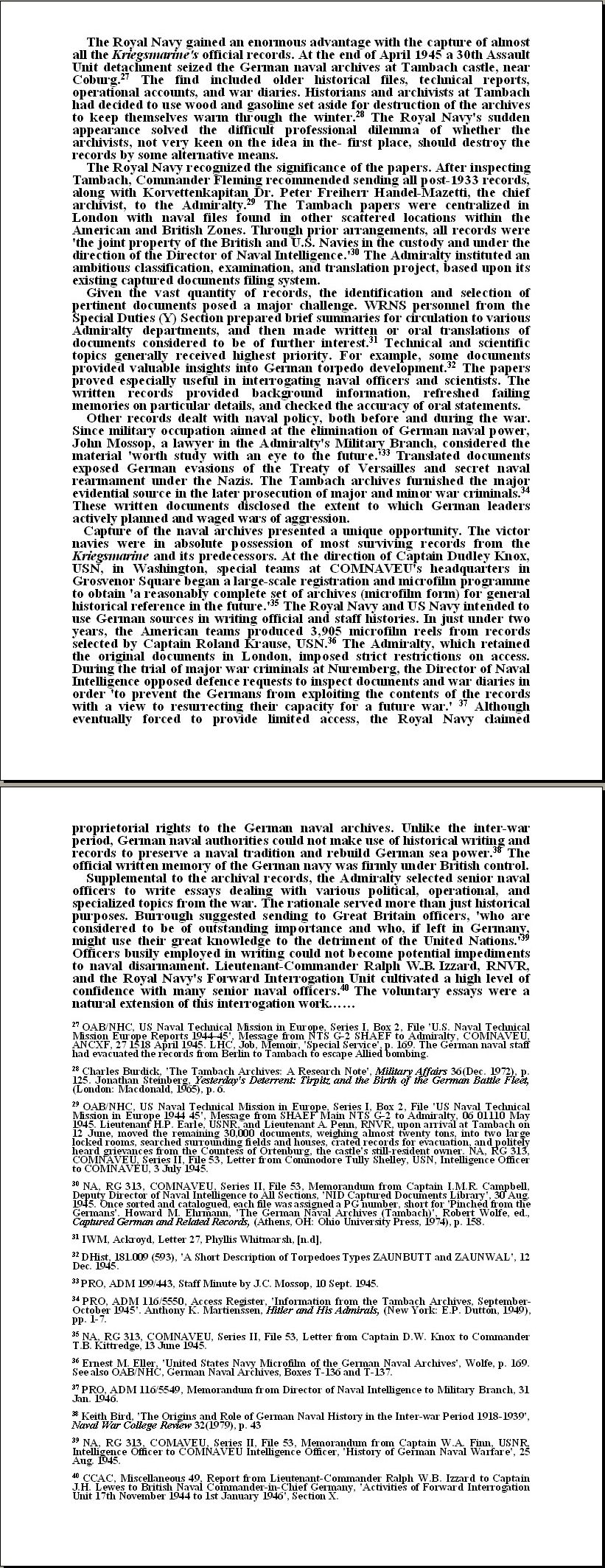
|
|

Schloss Tambach
Schloss Tambach Weitramsdorf
Jagd- und Fischereimuseum Schloss Tambach (Hunting & Fishing Museum)
U-Boat.Net
Location Map
Captured German and Related Records 
|
|
A wealth of information regarding records research is located here
 |
|
|
References: Hitler and His Admirals by Anthony Martienssen - Publisher: E.P. Dutton - New York 1949 Operation Mincemeat By Ben Macintyre - ISBN-13: 978-0307453273 - 2010 The Royal Navy and German Naval Disarmament 1942-1947 by Chris Madsen - ISBN 071464823X - 1998 Ian Fleming's Commandos: The Story of the Legendary 30 Assault Unit by Nicholas Rankin - ISBN 0199782822 - 2011 History Of 30 Assault Unit: Ian Fleming's Red Indians by Craig Cabell - ISBN 1844159507 - 2010 U-Boat Attack Logs - A Complete Record of Warship Sinkings from Original Sources 1939-1945 by Daniel Morgan & Bruce Taylor - ISBN 978-1-84832-118-2 - 2011 http://www.oldtimerfreunde-freising.de/Termine%201999-2010/Termine%202007/Tambach%202007/Innenhof%20Tambach%204.gif http://en.wikipedia.org/wiki/File:Schloss-Tambach2.jpg http://www.fischerjugend-unterfranken.de/images/Ausflug0808.jpg http://coburg-life.de/wp-content/uploads/2010/02/Tambach.jpg
|
|